
| Subject Area | Applications and Foundations of Computer Science |
|---|---|
| Semester | Semester 7 – Fall |
| Type | Elective |
| Teaching Method | Lectures |
| Teaching Hours | 4 |
| ECTS | 6 |
| Prerequisites |
|
| Course Director |
|


| Scientific Responsible |  Stamoulis Georgios, Professor Stamoulis Georgios, ProfessorE-mail: georges@uth.gr |
|---|---|
| Title | Hellenic Chips Competence Centre (HCCC) |
| Funding Agency | Το HCCC υποστηρίζεται από το Chips JU και τα μέλη του, και συγχρηματοδοτείται από την Ευρωπαϊκή Ένωση και την Ελληνική Κυβέρνηση μέσω του προγράμματος “Ανταγωνιστικότητα” |
| Budget | 326.350,00 |
| Duration | 01/06/2025 – 31/05/2029 |
| Scientific Responsible |  Plessas Fotios, Professor Plessas Fotios, ProfessorE-mail: fplessas@uth.gr |
|---|---|
| Title | Αναλογικός Σχεδιασμός, Δοκιμές και Επαλήθευση |
| Funding Agency | NanoZeta Technologies ltd. |
| Budget | 271.400,00 |
| Duration | 26/01/2021 – 25/01/2028 |
| Scientific Responsible |  Korakis Athanasios, Professor Korakis Athanasios, ProfessorE-mail: korakis@uth.gr |
|---|---|
| Title | DIGITAfrica: Towards a comprehensive pan-African research infrastructure in Digital Sciences |
| Funding Agency | ΕΥΡΩΠΑΪΚΗ ΕΝΩΣΗ |
| Budget | 123.125,00 |
| Duration | 16/12/2024 – 31/12/2027 |
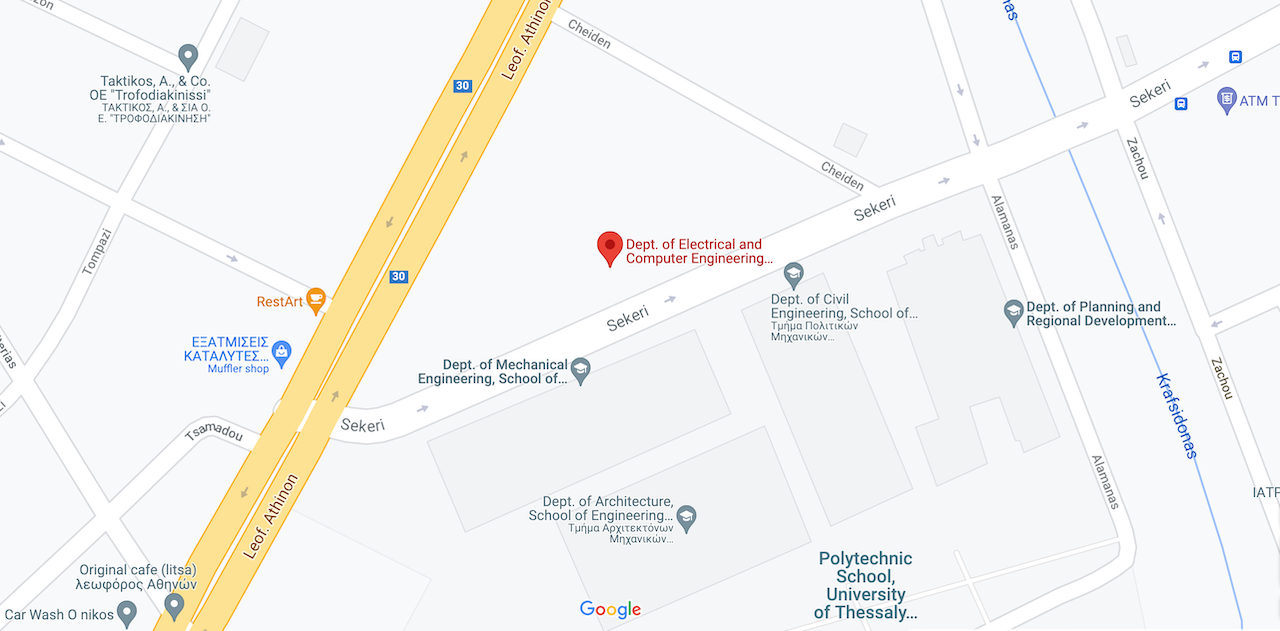
| Department of Electrical and Computer Engineering | |
|---|---|
| |
| Tel. | +30 24210 74967, +30 24210 74934 |
| gece ΑΤ uth.gr | |
| PGS Tel. | +30 24210 74933 |
| PGS e-mail | pgsec ΑΤ uth.gr |
| URL | https://www.e-ce.uth.gr/contact-info/?lang=en |

| Subject Area | Applications and Foundations of Computer Science |
|---|---|
| Semester | Semester 7 – Fall |
| Type | Elective |
| Teaching Method | Lectures |
| Teaching Hours | 4 |
| ECTS | 6 |
| Prerequisites |
|
| Course Director |
|
• Brief review of state-space systems, controllability, observability and state feedback
• Lyapunov theory: stability, direct method, Lyapunov equation and physical interpretation, extensions, global stability, invariant sets, region of attraction, input-to-state stability (ISS)
• Optimal control: problem formulation, Bellman’s principle of optimality and dynamic programming, Linear Quadratic Regulator (LQR): design, Riccati equation and interpretation
• Constrained systems: physical constraints and the need for Model Predictive Control, basic algorithm, feasibility, stability and performance-computational cost trade-offs, numerical solution and applications
• Set-based methods: invariant sets and safety concepts, reachability and safety verification under constraints
• Data-driven control methods, elements of reinforcement learning, hybrid systems, selected topics
The course deepens students’ understanding of advanced methods for the analysis and design of cyber-physical control systems. After successful completion of the course, students will be able to:
• analyse dynamic systems in state space in continuous and discrete time.
• use Lyapunov methods for stability and robustness analysis, including input-to-state stability.
• formulate and solve optimal control problems using dynamic programming, design LQR optimal controllers, and interpret their behaviour.
• apply Model Predictive Control.
• analyse constrained systems using set-based methods and safety concepts.
• be introduced to concepts of reinforcement learning and data-driven methods.
• apply advanced control techniques to real systems.
